Irkutsk’s Information Gap: Is There an Active Information-Management Campaign?
A warning disappears. News posts are removed. A regional leader qualifies his wording. The pattern deserves scrutiny, but proving a coordinated campaign requires more than a troubling sequence.
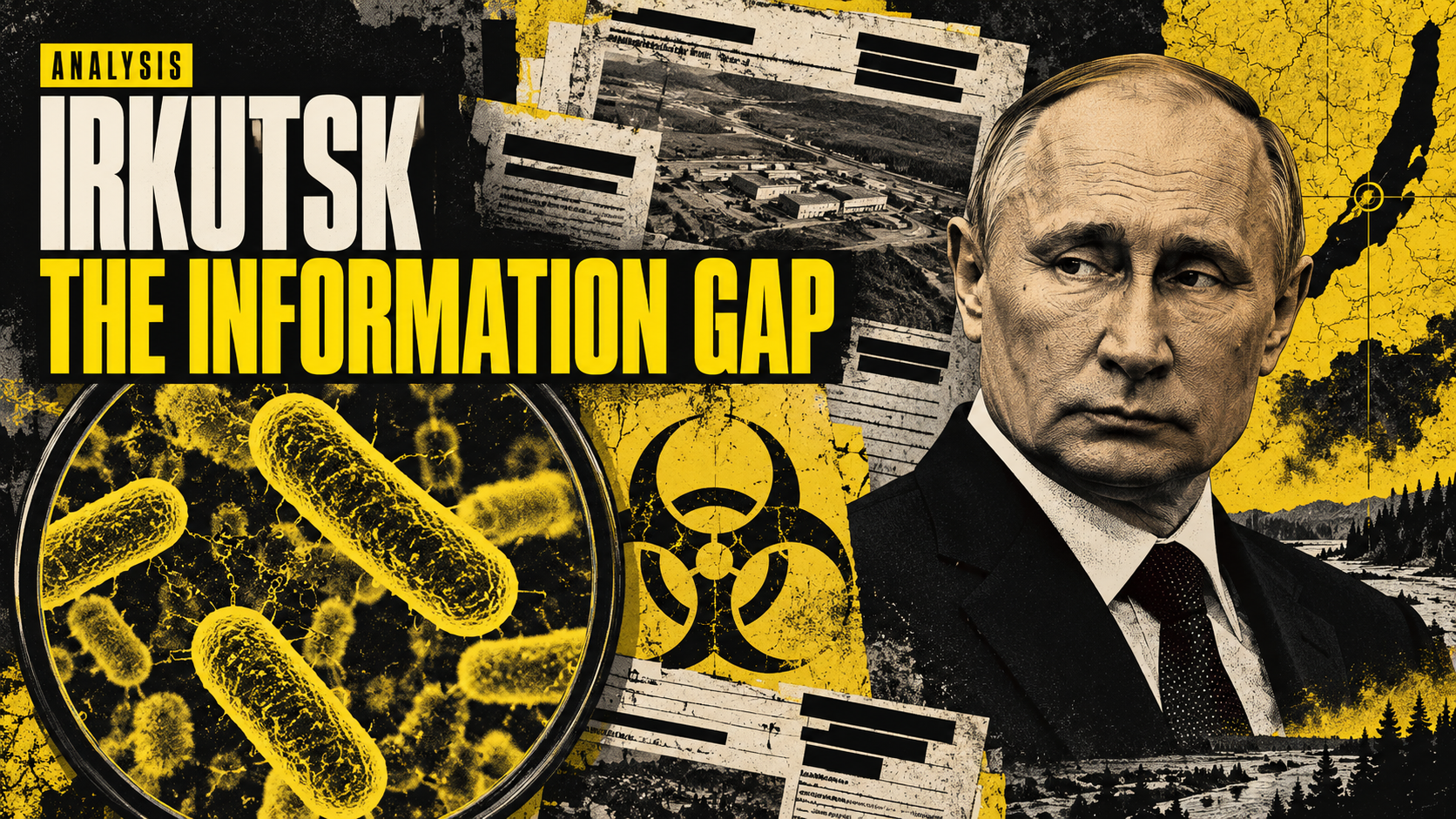
The suspected plague incident in Russia’s Irkutsk region has become a test of public communication as well as public health. Why did a municipal travel warning disappear? Why were news posts removed? And why has the public been left to reconcile forceful headlines with much more cautious official language?
A screenshot supplied to Irkutsk Live shows a post attributed to author Annie Jacobsen arguing that Russia is exercising sweeping information control. It points to deleted warnings, removed REN TV reports and an apparent lack of follow-up reporting, then asks whether further deaths are being concealed. Those concerns provide questions to investigate. They do not, by themselves, supply the answers.
The warning that lasted less than two hours
The Insider reported on 3 October that Baikalsk’s municipal Telegram channel published a warning at 08:28 local time asking residents to limit visits to Shelekhov and nearby settlements. By 10:21 it had disappeared. Crucially, the warning itself relied on unofficial information about a possible plague case. The outlet said no public explanation for its removal had been given.
That geography matters. The warning concerned Shelekhov, the reported hospital location. Describing it as a warning against visiting the site of a proven laboratory accident goes beyond the available evidence.
Current Time’s report of 3 October also describes the deleted warning. Both outlets cite People of Baikal for this episode, so their coverage should not be counted as two wholly independent discoveries. We have reviewed their reporting, not independently authenticated the deleted original.
Removed reports and a consequential word change
The Insider and Current Time also report that REN TV removed five Telegram posts about the incident. Current Time records another change: Buryatia’s leader Alexey Tsydenov added a qualification to his statement, saying the woman had possibly died of plague. These are material changes to the public record, and readers deserve an explanation.
The same Current Time report describes residents asking for clearer information and a promised local follow-up that had not appeared by its publication. Its account is dated 3 October. It is not evidence that every journalist subsequently stopped reporting: IRK.ru published a further report on 4 October about precautionary mask requirements at the aluminium plant. That article is evidence of continued coverage, not a fresh diagnostic result.
What official wording does, and does not, establish
The Shelekhov district administration’s 2 October statement, reviewed in our incident monitoring, describes a suspected especially dangerous infection, a meeting involving chief sanitary officer Anna Popova, and control measures. It says identified contacts had no symptoms and negative tests as of that date. It does not name the pathogen.
That leaves a significant information gap. It does not resolve the diagnosis, clinical form, exposure setting or subsequent condition of contacts. Equally, the absence of a newer public answer cannot be converted into evidence of additional deaths. The site’s reviewed figures remain one reported death and 197 reported contacts; contacts are not cases, and an unknown confirmed-case total is not zero.
Is this coordination, caution or institutional self-protection?
There are several plausible explanations for removing an early warning: correcting an unsupported claim, avoiding inconsistent travel advice, protecting patient information, reputational damage control, or obeying an instruction to suppress information. The public record reviewed here cannot choose confidently among them.
Nor are those explanations mutually exclusive. A legitimate effort to correct premature reporting can coexist with an institution’s wish to minimise embarrassment. The useful distinction is between coordinating accurate public-health advice and concealing information the public needs to act safely.
Evidence of a campaign would be stronger if authenticated directives, documented pressure on journalists, common instructions to separate organisations, or corroborated testimony connected the removals to a decision-maker. A list of disappearing posts shows an outcome. Establishing coordination requires evidence of the mechanism behind it.
Transparent corrections would help resolve the ambiguity: retain a notice that a post changed, explain what was wrong, identify what remains under investigation, and state when the next update will arrive. Quiet deletion makes it harder for readers to distinguish responsible revision from concealment.
The medical urgency needs accurate wording
The screenshot presents a categorical claim about death if antibiotics are not given within 24 hours. WHO’s plague guidance describes untreated pneumonic plague as fatal and stresses early treatment; CDC guidance says antibiotics should be given within 24 hours of symptom onset to reduce the chance of death. These statements convey urgency. They should not be turned into a universal clock after which every individual is certain to die.
The general severity of pneumonic plague is also not confirmation that this patient had that form. Anyone with possible exposure and concerning symptoms should seek urgent medical care and explain their exposure history. They should not wait for political clarity or a social-media update.
The bioweapons allegation is a separate evidentiary question
Jacobsen’s screenshot also invokes US assessments of Russian biological weapons activity. There is a primary historical basis for that broader concern: the US State Department’s 2021 arms-control compliance report assessed that Russia maintained an offensive biological weapons programme in violation of treaty obligations. This is a dated US government assessment, not an incident-specific finding.
It does not establish that the Irkutsk institute was doing weapons work, that the organism involved was engineered, or that this event was a release from such a programme. We have not verified the screenshot’s additional assertion that only two countries fall into its stated category. The supplied image cuts off the rest of that discussion; we do not reconstruct unseen claims.
The questions authorities could answer now
- Who removed the Baikalsk warning and REN TV posts, and what reasons or corrections were recorded?
- Was either organisation asked to alter its reporting by a public authority?
- What diagnosis and clinical form have laboratory testing and medical review established?
- As of a stated date and time, how many contacts have symptoms, positive tests or precautionary admissions?
- Have any further deaths or illnesses been epidemiologically linked to the original reported patient?
- What is the next scheduled public update, and which agency is accountable for it?
On the present evidence, asking whether there is an active information-management campaign is justified. Declaring one proven is premature. The most consequential missing information is still practical: what happened, whether anyone else is ill, and what affected people should do.
Help examine those gaps in our Top Unanswered Questions discussion. Bring dated sources and distinguish first-hand evidence from repeated claims.
Source and method note: this is analysis, dated 4 October 2026. The supplied screenshot is the basis for describing Jacobsen’s argument; its complete text, timestamp and original post URL were not available for verification. Deletion accounts are attributed to the linked reporting. The State Department archive returned a technical error when opened; its 2021 assessment was available in the indexed official report text. No claim is made that we contacted the authorities or established a motive. Read our methodology and evidence review; the homepage carries subsequent reviewed developments.